
A Soulless Formalism
PTI, the Supreme Court, and the Erosion of Democratic Trust

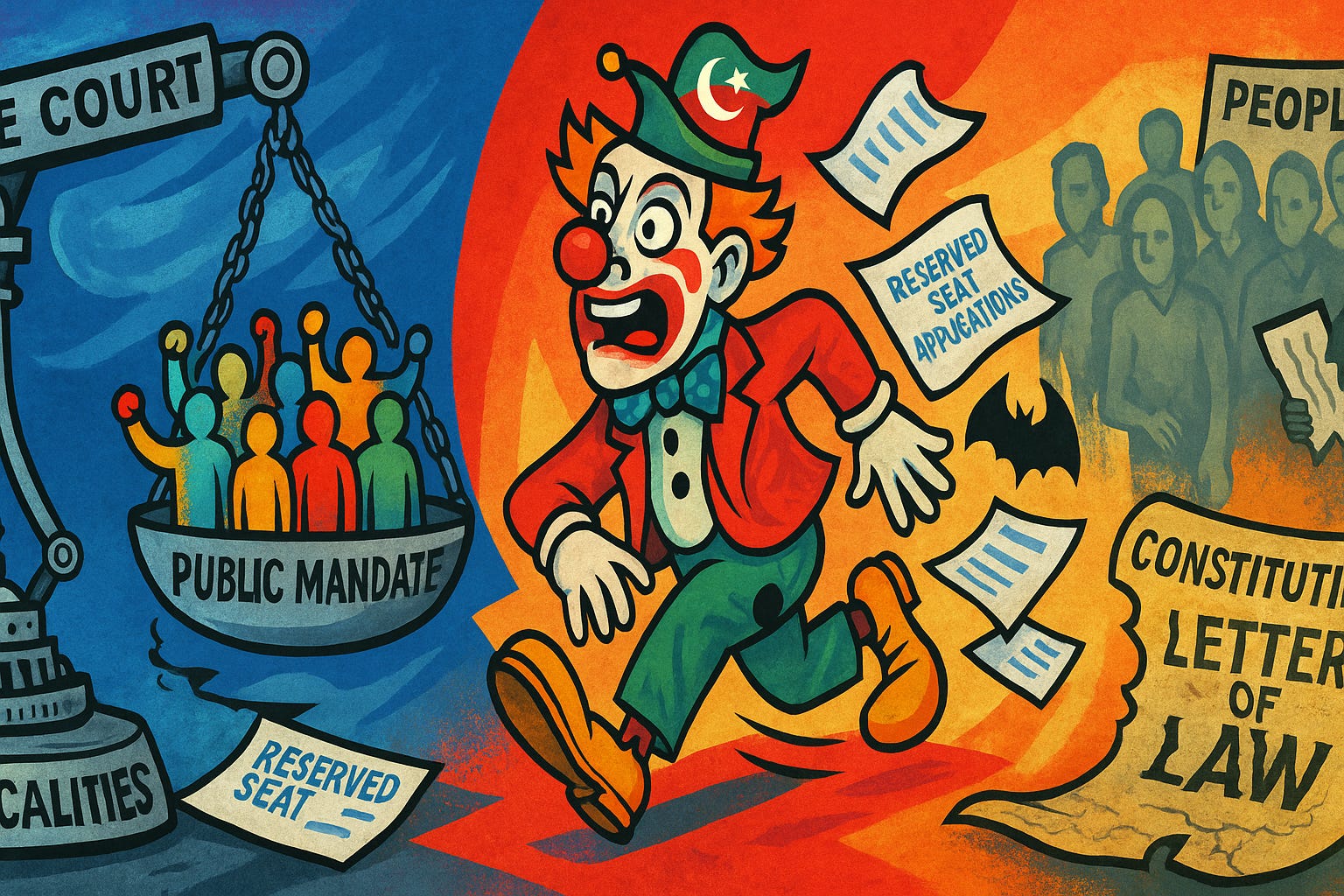
The Supreme Court’s recent verdict denying reserved seats to PTI-backed independents is more than a ruling on electoral procedure; it is a stark reflection of how rigid formalism, when applied without sensitivity to democratic realities, can deepen the public’s alienation from law itself. By adhering strictly to procedural technicalities, the Court reinforced that constitutional rights must be exercised within defined frameworks. Yet when law is applied as a lifeless code — divorced from the popular mandate and political reality — it ceases to serve as an instrument of justice and begins to appear as a tool of exclusion. A legal system that claims to uphold democracy cannot sustain public trust if it ignores the spirit of representation in favour of narrow technical compliance.
But the primary architect of this fiasco is PTI itself. A party with a formidable public mandate squandered its position through hubris, disorganisation, and a fatal reliance on political theatrics rather than constitutional discipline. The failure to file timely lists for reserved seats, the inability to safeguard its symbol, and a broader contempt for procedural obligations provided the very grounds for the Court’s strict application of the law. Even the smallest political entities manage to comply with these requirements. PTI’s leadership, driven by haughtiness and mendacity, treated law as a hurdle to be defied rather than a framework to be honoured. The Supreme Court’s formalism was not arbitrary; it was enabled — indeed invited — by PTI’s own disregard for legal responsibility.
The conduct of PTI’s legal team before the Court sealed its fate. When counsel abandon legal reasoning in favour of grandstanding and address the highest bench without the professional restraint that the Supreme Court commands, they forfeit the expectation of judicial latitude. The courtroom is not a venue for political spectacle; it is the final safeguard of constitutional continuity. PTI’s lawyers should have interrogated the law’s application, not sought to contest facts face-to-face with the judges in a manner designed for political messaging rather than legal remedy. The Court, confronted with such conduct, acted within its authority to enforce procedural rectitude — if only to close the door on future disregard for constitutional process by those who aspire to high office.
What this episode lays bare is the deeper crisis in Pakistan’s democratic and legal culture. Law, if reduced to a mechanical trap for procedural error, loses its legitimacy. But law also cannot endlessly compensate for political indiscipline disguised as grievance. A constitutional order depends on balance: where courts preserve both the integrity of procedure and the reality of representation, and where political actors approach law as a partner in democratic stability, not as an obstacle to be outwitted. The tragedy here is not that the Court upheld formalism — it is that PTI’s political conduct left the Court with no just alternative.